
Everyone wants lower CPCs. It sounds like the obvious goal, right?
Pay less per click, receive more traffic for your money, make more profit.
But here's the truth that nobody talks about: decreasing your CPCs is not always a good thing. In fact, chasing lower CPCs without understanding the bigger picture can actually hurt your results.
I have been running Big Flare for over 12 years now, and I have helped hundreds of businesses scale with Google Ads. Today I want to share the truth about CPCs that most advertisers miss, plus five smart optimisation strategies that can actually reduce your costs without blocking access to your highest-value customers.
The Contrarian Truth About CPCs
Here's the thing: you cannot look at CPC in isolation.
What matters is how much money you make, not how cheap your clicks are. CPC is only one part of the equation that determines how much revenue you generate. You also need to factor in conversion rate and average order value.
Here's the critical insight that most advertisers miss: CPC going up can actually be a GOOD thing if that traffic converts at a much higher rate or has a much higher average order value.
Why?
Because conversion rate and AOV are often highly related to the CPC you're paying. As you or Google's algorithm finds better traffic that's more likely to convert and buy more, the CPC for that traffic is naturally going to be higher. Higher value traffic will also have a higher cost, because that's the traffic all other advertisers want as well.
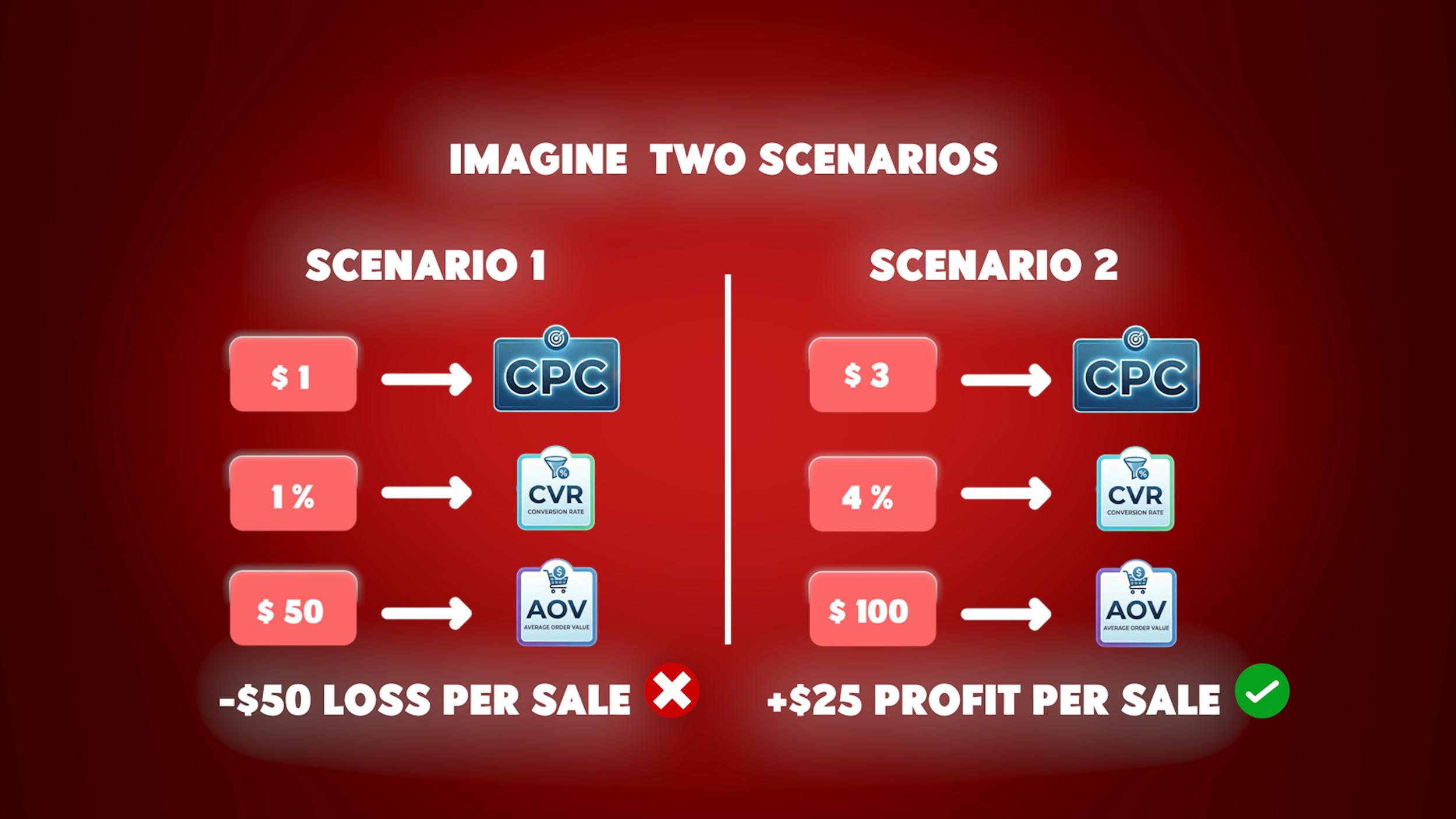
Let me illustrate with an example.
In scenario one, you're paying $1 per click with a 1% conversion rate and a $50 average order value.
In scenario two, you're paying $3 per click with a 4% conversion rate and a $100 average order value.
In scenario one, you're spending $100 to make one $50 sale. You're losing money.
In scenario two, you're spending $75 to make one $100 sale. You're making $25 profit per sale.
The higher CPC scenario is actually far more profitable, and if you ask me, I would rather have that higher CPC traffic, thank you very much.
This is why I do not recommend adding maximum CPC bid limits when using automated bidding strategies focused on conversions. Yes, CPC limits will lower your average CPC. But they also prevent Google from bidding on your highest-value users. Limiting CPCs typically harms revenue more than it helps.
The Smart Approach: 5 Strategies That Actually Work
With all that said, there ARE smart optimisation techniques that can reduce your CPC without blocking access to high-intent buyers. These 5 strategies improve efficiency without sacrificing performance.
Strategy 1: Quality Score Optimisation
This applies specifically to your Search campaigns. Improving your Quality Score reduces your CPC because Google rewards advertisers who provide a good experience with lower costs.
Quality Score is determined by three factors: expected click-through rate, ad relevance, and landing page experience. I recommend focusing on expected CTR and ad relevance first, as these have the biggest and fastest impact.
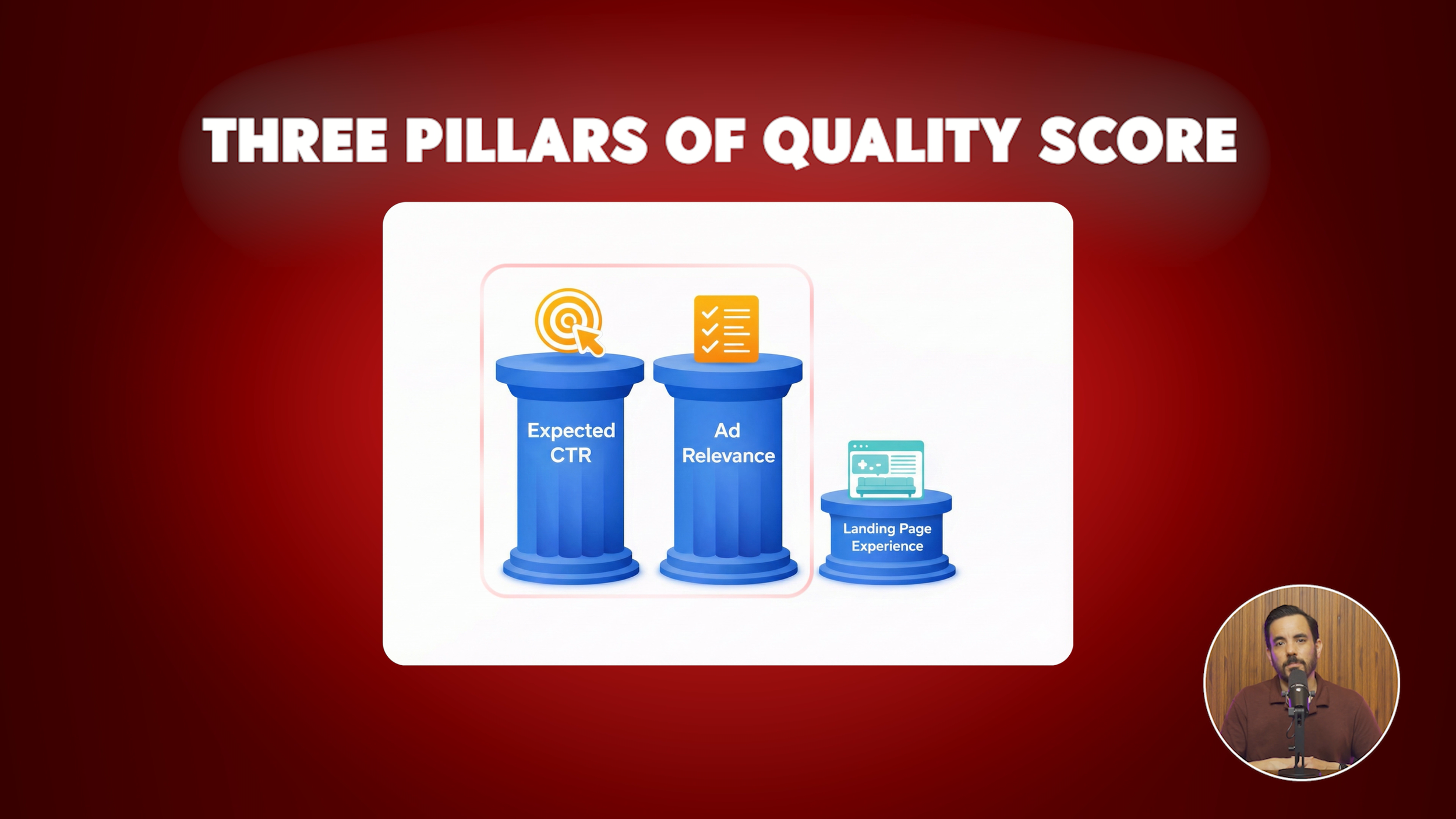
Improving Click-Through Rate: Write better ads that compel people to click. Test different headlines. Include pricing or offers when relevant. Use emotional triggers or urgency like "limited time" or "best seller".
Improving Relevance: Tighten your ad groups so keywords closely match your ad copy. If you have an ad group with twenty different keywords and one generic ad, your relevance will suffer. Group similar keywords together and write ads that specifically speak to those keywords. Make sure your landing page contains the keywords you're targeting.
Improving Landing Page Experience: Page load speed matters. If your page takes more than three seconds to load on mobile, you're losing Quality Score points. Ensure excellent mobile experience and add trust signals like reviews, guarantees, and secure checkout badges.
Strategy 2: Product Image Optimisation
This is one of the biggest CPC levers you have in Shopping and Performance Max campaigns. Better images lead to higher click-through rates, and Google rewards higher CTR with cheaper CPCs.

Here are the image quality improvements that matter most:
First, use high resolution images with sharp focus. Blurry or pixelated images scream "unprofessional" and people scroll right past them.
Second, start with a clean white or neutral background as your base image. These make your product pop in the Shopping carousel.
Third, make sure your product takes up most of the frame. A tiny product in a sea of white space will not stand out against competitors.
Fourth, test showing your product in use or in a lifestyle context against the plain white background to see which achieves higher CTR. A yoga mat shown with a person doing yoga will often outperform the same yoga mat photographed flat.
Fifth, test multiple angles or variations. What works for one product category might not work for another. Even small CTR improvements of 10 to 20% can translate to meaningful CPC reductions over time.
Strategy 3: Break Out High-Spend, Low-ROAS Products
This applies to both Shopping and Performance Max campaigns. In most ecommerce accounts, you'll have some products that spend a lot but deliver poor ROAS. These products drag down your overall performance and push up your overall CPC.
The solution is to move them into their own dedicated campaign. Then set a higher target ROAS on that campaign than their previous average performance. This forces Google to bid less aggressively on those products.
For example, say you have a product spending $1,000 per month but only delivering 250% ROAS. Move that product to its own dedicated campaign and set a 400% target ROAS. Now Google will reduce CPCs on those high-cost products because it needs to hit that higher efficiency target. Your CPC decreases, and whatever spend remains is much more efficient.
Strategy 4: Ad Assets and Extensions
This might sound basic, but I see so many accounts missing obvious opportunities here. Make sure every relevant asset and extension is set up.
Extensions increase your ad size and visibility on the search results page. When your ad takes up more real estate, people are more likely to notice it and click. That higher CTR reduces your CPC.
Focus especially on Sitelinks. Add Sitelinks at the account level for broad coverage, but also add campaign-level Sitelinks tailored to your top-spending campaigns. For a home goods store, account-level Sitelinks might be "Shop Sale", "Free Shipping", and "Best Sellers". But for a specific "Bedding" campaign, you'd add "Shop Duvet Covers", "Shop Pillows", and "Shop Sheets".
Beyond Sitelinks, set up Callouts for benefits like "Free Shipping" and "30-Day Returns". Structured snippets let you list product categories. Promotion extensions display sales directly in the ad. Image extensions add visual appeal to text ads.
Strategy 5: Asset Optimisation in Performance Max
This one comes with an important caveat: only focus on this if those placements are actually driving meaningful volume.
Performance Max shows ads across multiple channels: Search, Shopping, Display, YouTube, Discover, and Gmail. But not all channels will drive equal results for your business.
Before optimising creatives, check your Channel Performance report first. In Google Ads, click into your Performance Max campaign and select the Channel Performance report. Scroll down to the table at the bottom and make sure you have columns enabled for conversion value over cost.
If YouTube drives only 3% of your clicks, video optimisation is not a priority. But if Display drives 40% of your traffic, image quality becomes absolutely critical.
Once you've identified which creative type to optimise, head to your asset groups and click "view asset details". Look at CTR and ROAS for your assets. Examine your top performers to understand what works, then swap out your lowest performing creatives with new assets crafted using those learnings.
Conclusion
The key takeaway is that lower CPCs are not always better. What matters is profitability, not the cost of individual clicks. Higher CPC traffic often converts better and delivers higher average order values, making it more profitable despite the higher click cost.
That said, here are five smart strategies to reduce CPCs without blocking your best customers:
Quality Score Optimisation - Improve expected CTR, ad relevance, and landing page experience in your Search campaigns
Product Image Optimisation - Use high-quality, professional images that boost CTR in Shopping and Performance Max campaigns
Break Out High-Spend, Low-ROAS Products - Move underperformers to dedicated campaigns with higher target ROAS
Ad Assets and Extensions - Set up comprehensive Sitelinks, Callouts, Structured Snippets, and Promotions
Performance Max Asset Optimisation - Focus creative improvements on the channels that actually drive meaningful volume
Each of these strategies either improves the quality signals Google sees from your ads, or cuts wasted spend on irrelevant traffic.